
Wasp Nest on Your Georgetown Home? What to Do and What Not to Do
Key takeaways
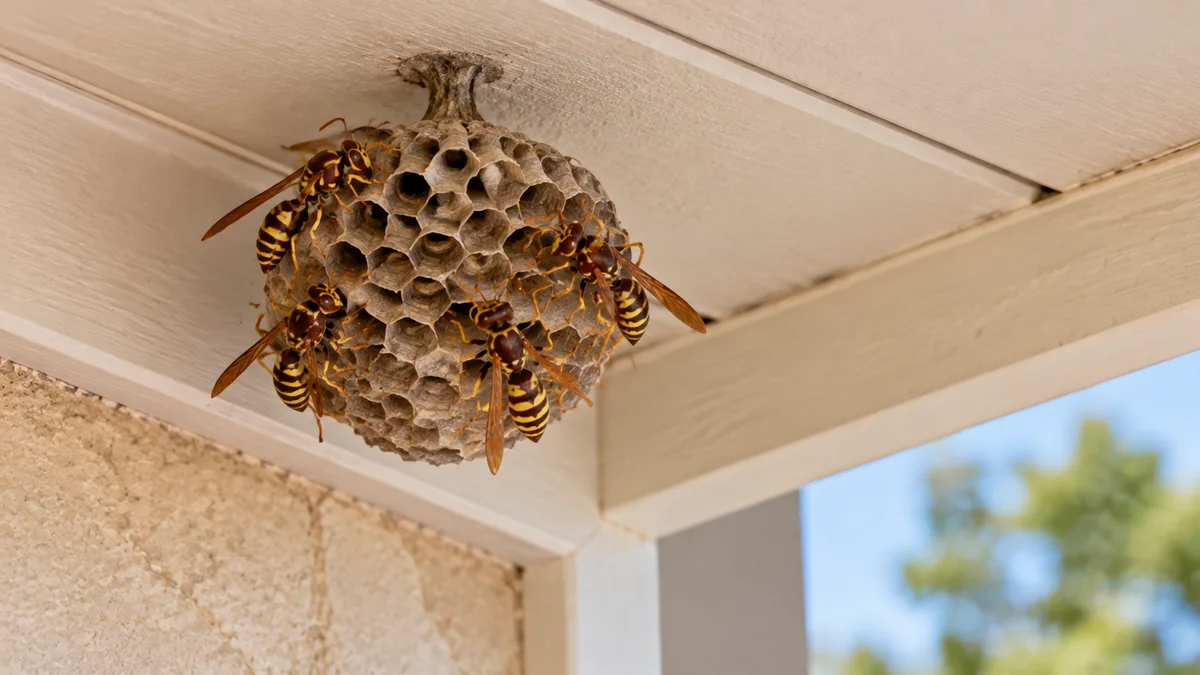
- Wasp nest removal starts with knowing the insect: paper wasps build open combs; yellow jackets hide nests in the ground or walls.
- Small paper wasp nests within reach can be handled carefully; yellow jacket nests, high nests and nests in walls are for a professional.
- Honey bees are different and should go to a beekeeper.
Georgetown’s long warm season gives wasps from March to November to build, and the city’s two-story homes, deep porches and play sets give them plenty of sheltered spots. Most nests are found by accident: someone opens the grill, mows over a hole in the lawn or looks up while unlocking the front door. Here is how to handle what you find.
Which insect is it?
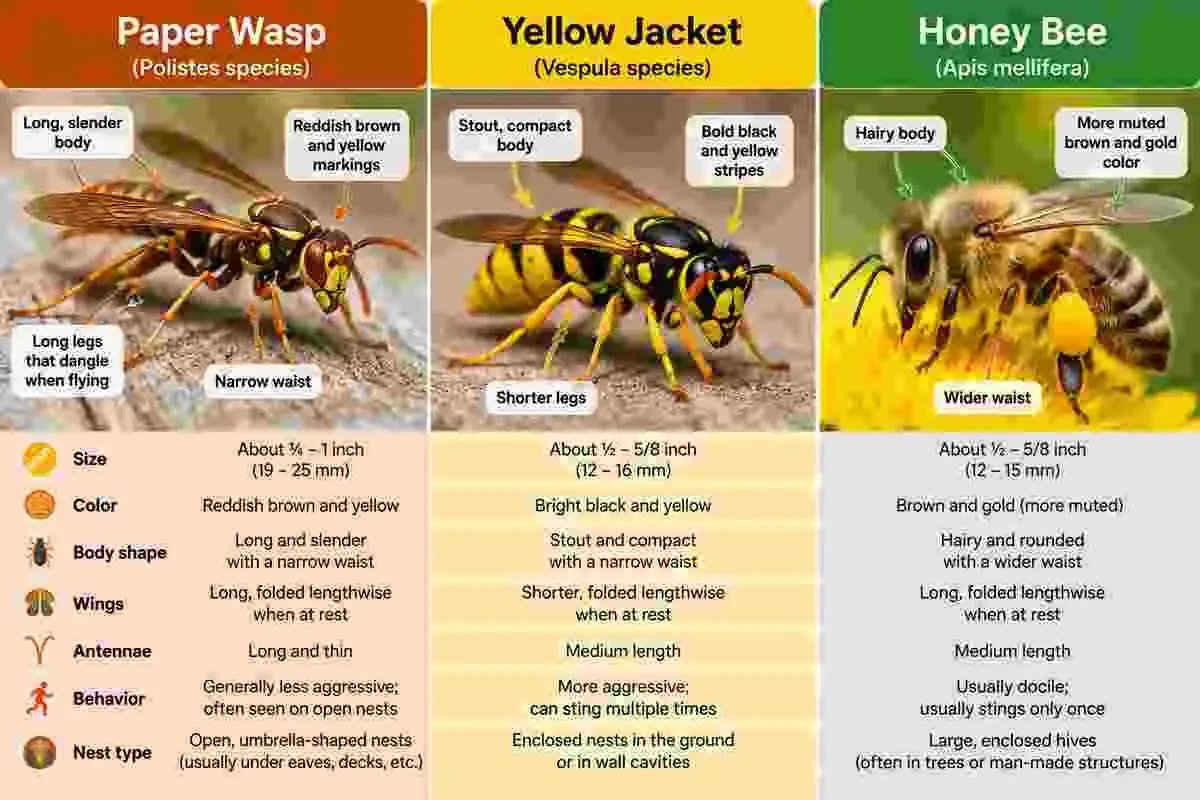
| Paper wasp | Yellow jacket | Honey bee | |
|---|---|---|---|
| Body | Long and slender, legs dangle in flight | Short, stout, bright yellow and black | Fuzzy, golden-brown |
| Nest | Open, umbrella-shaped comb hanging from a stalk | Hidden: ground holes, wall voids, attics | Wax comb in hollow spaces; swarms hang in clusters |
| Typical spot in Georgetown | Eaves, porch ceilings, play sets, light fixtures | Lawns, under landscape timbers, gaps in siding | Wall voids, trees, meter boxes |
| Temperament | Defensive near the nest | Aggressive, stings repeatedly | Usually calm away from the hive |
| Who handles it | You (small nests) or an exterminator | An exterminator | A beekeeper |
Seven do’s and don’ts for a wasp nest
Do:
- Do identify it first. The right response depends entirely on whether it is a paper wasp, a yellow jacket or a honey bee.
- Do act early. In March and April, a paper wasp nest is a single queen and a few cells. Knocking it down then is easy.
- Do treat small, reachable nests at night, when wasps are inside and less active, using a labeled product and protective clothing, if no one in the home is allergic.
Don’t:
- Don’t spray from a ladder. A defensive swarm and a ladder are a dangerous combination.
- Don’t plug a hole in the wall or ground. Yellow jackets will chew another way out, sometimes into the house.
- Don’t pour gasoline or set fire to a nest. It is dangerous and illegal in many places, and it often fails.
- Don’t knock down a nest without killing the colony. They rebuild nearby within days.
A spring walk-around: where nests start
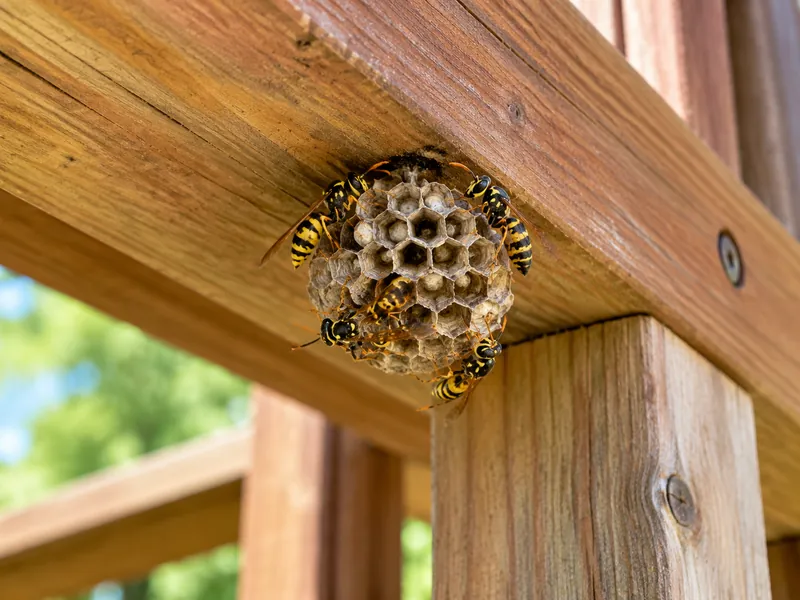
Founding queens pick sheltered, dry spots with a roof over them, and they pick the same kinds of spots on almost every house in town. A ten-minute lap around the property every couple of weeks from March through May catches a new wasp nest while they are still the size of a bottle cap. Bring a flashlight and look up and under, not just at eye level.
- The grill and its cover. Lids that stay closed for weeks over winter are a favorite. Lift slowly and look at the underside before lighting it.
- Mailboxes and the electric meter. Brick mailbox columns with a hollow cap and the gap behind a meter base both get used. The AgriLife entomologists specifically call out mailboxes and doghouses as places to check (Texas A&M AgriLife).
- Porch ceilings, light fixtures and the top of door frames. Deep covered entries on newer two-story builds give paper wasps shade all afternoon.
- Play sets, trampolines and pergolas. Hollow cross beams and the underside of slides sit untouched for days at a time.
- Window shutters and the AC disconnect box. Decorative shutters leave a narrow, shaded gap against the wall; the disconnect box beside the condenser has a hinged cover wasps can slip under.
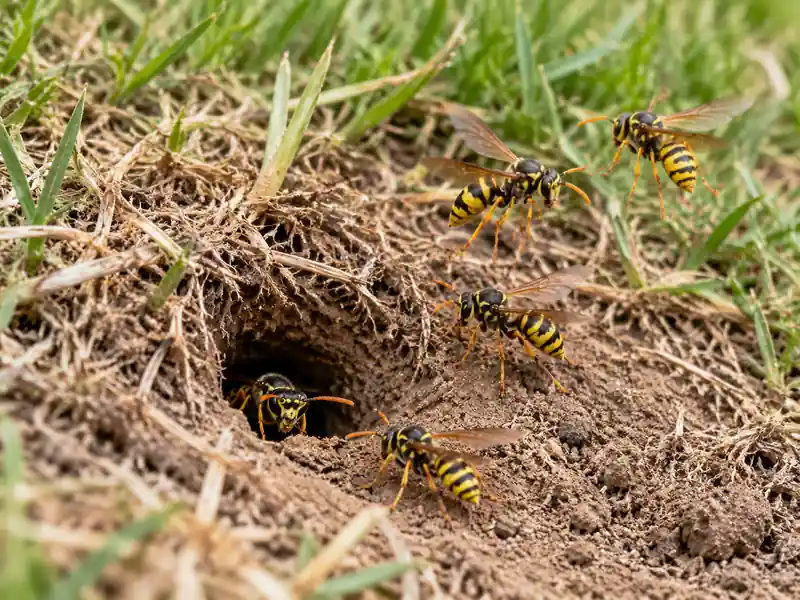
- Irrigation valve boxes and old rodent holes. These are yellow jacket spots, not paper wasp spots. If the lid of a sprinkler box has a steady line of traffic in and out, leave it closed and mark it.
Anything you find in March or April is usually one queen and a handful of cells. The same wasp nest left alone until August can hold a nest the size of a dinner plate with dozens of defensive adults on it.
Nests in walls and eaves on two-story homes
Two-story homes, common in newer subdivisions like Wolf Ranch, put eaves and soffits 20 feet or more off the ground. Nests up there need the right equipment. Yellow jackets that come and go from a gap in the siding, a soffit vent or a hole near a window may be building a nest much bigger than anything you can see. In late summer, a wall nest can hold thousands of wasps.
Signs of a wall nest:
- A steady stream of wasps flying in and out of one gap
- A faint rustling or scratching sound in the wall
- Wasps appearing inside the house near lights or windows
- A damp or soft spot on drywall
Leave wall nests alone and have them treated professionally. Usually, a dust is applied into the void through the entry point, and the gap is sealed after the colony dies.
Mowing season and ground nests
Most yellow jacket stings in a typical yard happen behind a mower or a string trimmer. Vibration over a ground nest is enough to send the colony out, and they can sting more than once. If you have seen wasps dropping into a hole in the lawn or a flower bed, flag it and mow around it until it has been treated. If they come after you, get inside a closed space rather than swatting, which the AgriLife article also recommends.
Honey bees need different handling
Honey bees are valuable pollinators, and beekeepers often remove and relocate colonies alive. This site does not handle honey bee calls. If you see a ball-shaped cluster of bees on a branch in spring, it is usually a swarm resting before moving on; give it a day. For bees living in a wall, contact a local beekeeper through the Texas Beekeepers Association. Comb and honey left in the wall should be removed so they do not attract pests or damage the wall.
When to call
Call an independent local exterminator for:
- Any yellow jacket nest, in the ground or in a structure
- Nests higher than you can reach from the ground
- Nests inside walls, attics, soffits or vents
- Large paper wasp nests in late summer
- Any nest when someone in the home is allergic to stings
What a professional visit usually involves
Knowing what to expect makes it easier to judge whether the technician did the job right. A typical wasp nest call, whether it is paper wasps or yellow jackets, goes roughly like this:
- The technician confirms the species and finds the actual entry point, which on a wall nest is not always where you have been seeing the wasps.
- Open paper wasp combs are treated and then physically removed, so new queens are less drawn to the spot next spring.
- For wall voids and ground nests, an insecticide dust is puffed into the entry. Foragers carry it through the colony, and activity usually drops off over a day or two.
- The gap is sealed only after the nest is dead. Sealing it early traps live wasps that will look for another exit, sometimes through a light fixture or an outlet cover into the house.
- Ask what product was used and how long to keep kids and pets away from treated areas. A licensed applicator in Texas should be able to answer that without hesitation.
Keeping them from coming back next spring
An old wasp nest is not reused, but the same sheltered corner keeps attracting new queens year after year. A few habits cut down the repeat business:
- Knock down any small nest the day you see it in early spring, and wash the spot afterward so leftover scent does not draw the next queen.
- Screen soffit and gable vents that have torn mesh, and caulk gaps around exterior light fixtures, hose bibs and cable entries before March.
- Keep tight lids on trash and recycling bins, rinse soda cans before they go in, and pick up fallen fruit under peach or fig trees. Yellow jackets switch to sweets and scavenging in late summer and fall.
- Bring pet food bowls inside after feeding and clean up drips around hummingbird feeders.
- Do a quick check of the grill, play set and porch ceiling every couple of weeks through May. Early is everything with wasps.
Wasp nest questions
What should I do after a wasp sting?
Move away from the nest, wash the area and use a cold pack. Call 911 for swelling of the face or throat, trouble breathing, dizziness, hives spreading over the body or many stings at once.
Will wasps come back to the same nest?
Old nests are not reused, but the same sheltered spot attracts new queens each spring. Check those spots early and treat the surface if needed.
Are mud daubers dangerous?
Mud daubers rarely sting. Their mud tubes can be scraped off walls once they are empty.
When is wasp season worst in Georgetown?
Late summer and early fall, when nests are largest and wasps search for sugary food around trash cans and patios.
Keep reading
- Spider exterminator in Georgetown: black widows like the same porch corners
- Pests in Wolf Ranch
- Back to the Georgetown exterminator homepage
Sources: Texas A&M AgriLife Extension · AgriLife Insects in the City: getting along with wasps and hornets · Texas Beekeepers Association