
How to Choose an Exterminator in Georgetown, TX: Questions to Ask Before You Sign

Key takeaways
- How to find a good exterminator comes down to a careful inspection, clear answers and terms in writing.
- Know whether you are buying a one-time treatment or an ongoing plan, and how to cancel.
- Never sign a multi-year agreement at the door the first time someone knocks.
Every summer, door-to-door sales crews work through Georgetown subdivisions, especially the newer ones. Online, dozens of companies compete for the same searches. Most are honest, but the difference between a good experience and a bad one usually comes down to a few questions asked before signing. This post lists those questions. We do not name or rank any company; the goal is to help you judge any of them. Knowing how to choose an exterminator comes down to asking a few specific questions and reading the paperwork.
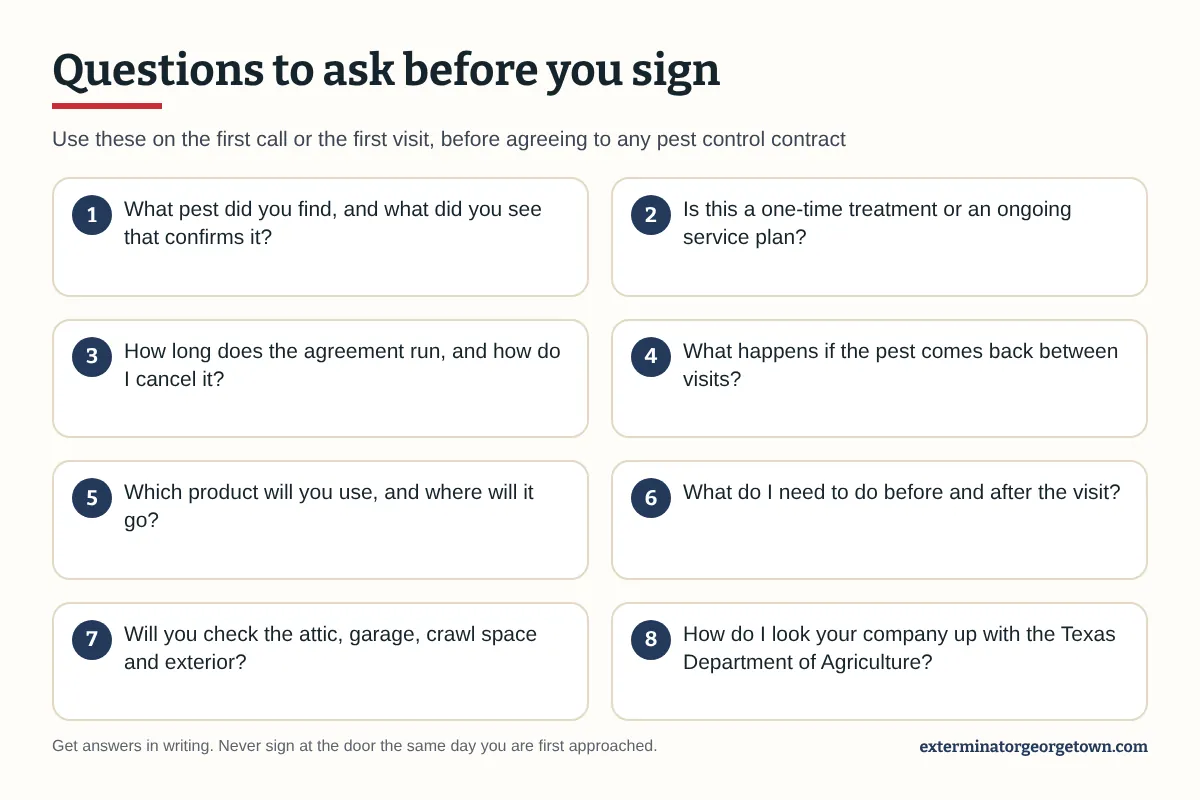
How to choose an exterminator: what to ask on the first call
- What pest did you find, and what did you see that confirms it? A good technician points to droppings, mud tubes, live insects or entry points, not just a guess.
- Is this a one-time treatment or an ongoing service plan? Both can be right. You should know which you are buying.
- How long does the agreement run, and how do I cancel? Look for the length, auto-renewal terms and any cancellation fee.
- What happens if the pest comes back between visits? Ask whether re-service calls are included and how quickly they respond.
- Which product will you use, and where will it go? You are entitled to know what is applied in and around your home.
- What do I need to do before and after the visit? Preparation affects results. See our exterminator prep checklist.
- Will you inspect the attic, garage, crawl space and exterior? A real inspection covers more than baseboards.
- How do I look your company up with the Texas Department of Agriculture? The TDA regulates structural pest control businesses in Texas and offers a public lookup on its website.
Contract length and cancellation terms
Read the agreement before you sign, including the back page. Things to look for:
- Term: month-to-month, 12 months, or longer. Multi-year agreements are where most complaints start.
- Auto-renewal: whether the agreement renews automatically and how much notice is required to stop it.
- Cancellation: fees for ending early, and how notice must be given.
- Initial service charge: some plans charge more for the first visit than for later ones. Know both numbers.
- What is covered: which pests, which areas and whether termites are included or separate.
- Re-service: whether call-backs between visits are included.
Consumer complaints about pest control often involve long agreements signed at the door, followed by trouble canceling. The Federal Trade Commission’s guidance on door-to-door sales explains your right to cancel some in-home sales within three business days. You can avoid most of these problems by never signing the first time someone knocks, and asking for the agreement to review on your own time.

What a proper visit includes
- An inspection before treatment, inside and out, focused on the pest you have
- A clear explanation of what was found and where
- Treatment targeted to harborage and entry points rather than a quick spray around the baseboards
- Recommendations for sealing, moisture and landscaping changes
- A written service report with the products used
One-time versus quarterly service
| One-time treatment | Ongoing (often quarterly) plan | |
|---|---|---|
| Good for | A specific problem with a clear end: a wasp nest, a German cockroach clean-out (with follow-ups), a rodent job with exclusion | Steady pressure from outside: scorpions on the west side, ants, spiders |
| What to ask | How many follow-up visits are included | Visit frequency, what each visit includes, re-service between visits |
| Watch out for | Problems that need a second visit but are sold as “one and done” | Long agreements that renew automatically |
How often should you get pest control? It depends on the pest and the property. Termite protection runs yearly. West Georgetown homes with constant scorpion pressure often choose quarterly exterior service. A clean, sealed home on the east side may need nothing routine.

In Georgetown, the answer often depends on which side of town you live on. Homes on the limestone west of I-35, in places like Wolf Ranch or near the river, tend to see scorpions every summer, and a recurring exterior service with an attic treatment can make sense there. A house on the east side with a one-time German cockroach problem that came in on a used appliance usually needs a focused treatment and one or two follow-ups, not a year-long contract. Ask the company to explain why they recommend a plan for your address specifically, and be wary of anyone who offers the same plan to every house on the street.
Questions that matter for Georgetown pests
General questions only go so far. Georgetown has a handful of pests that need specific methods, so ask how each company handles the ones you actually have:
- Scorpions: Does the service include the attic, eaves and weep holes, or only a spray at the foundation? Striped bark scorpions climb, and a ground-level treatment alone rarely holds them back.
- Termites: Is the treatment a liquid barrier, a bait system or both, and does the warranty transfer if you sell the house? With as many resales as Georgetown sees, a transferable warranty can matter at closing.
- Fire ants: Will they use a broadcast bait across the yard or only treat visible mounds? Baits work best in spring and fall while the ants are actively foraging.
- Roof rats: Is exclusion, meaning sealing the entry points, included and guaranteed, or is the quote only for traps and bait boxes?
A company that answers these clearly, and is willing to put the answers in writing, is usually one that has worked in Georgetown long enough to know what fails here. Write their answers down during the call so you can compare companies later.
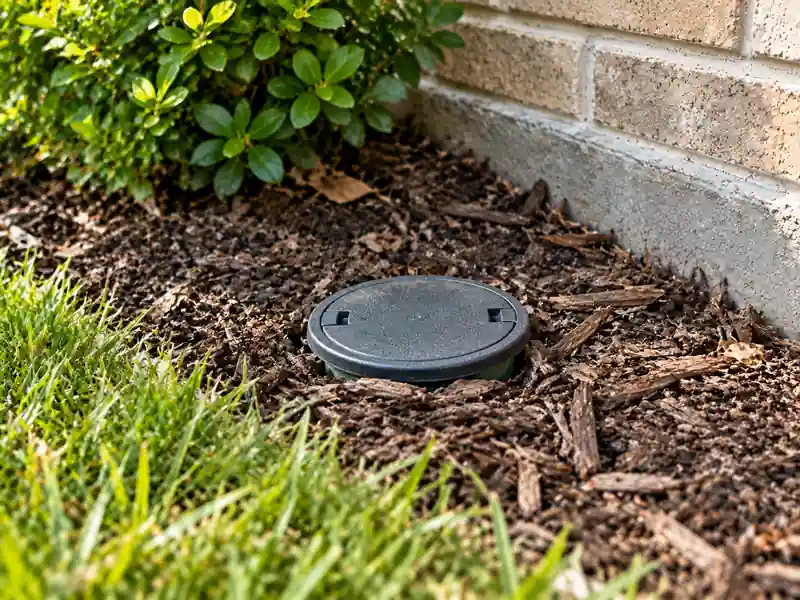
What a written quote should spell out
Two quotes for the same house can look wildly different simply because they describe different jobs. Before comparing prices, make sure each one tells you the same basic things in writing:
- The pest and the evidence. “German cockroaches, heavy activity under the kitchen sink and dishwasher” is a diagnosis. “General pest service” is not.
- Where the work happens. Interior, exterior perimeter, attic, garage, crawl space or yard, listed area by area.
- The products or methods. Baits, dusts, sprays, a liquid termite barrier, bait stations or exclusion work. You can look up any product label on the EPA’s pesticide database.
- Follow-up visits. How many are included, how far apart, and whether a call-back between visits costs extra.
- Any guarantee and its limits. What is covered, for how long, and what you must do to keep it valid, such as keeping mulch off the slab or fixing a leak.
- The total cost and the payment schedule, including any initial fee on top of recurring visits.
Once two quotes describe the same scope, the comparison gets easy, and it often turns out the cheaper one simply left out the attic or the follow-up visit. If a company will not put these details in writing, treat that as the answer.
Red flags
- Pressure to sign today for a “neighborhood special”
- Treatment offered without any inspection
- Vague answers about what product will be used
- A multi-year agreement presented as standard for a simple problem
- Claims that a single spray will solve termites, bed bugs or German cockroaches
- Reluctance to give you the agreement to read before signing
- No written service report after the visit
Pest control contract questions
Is it worth paying for pest control in Georgetown?
For many homes, yes, especially on the west side for scorpions and anywhere for termites. The key is matching the service to the pest you actually have.
Can I cancel a pest control contract?
Usually, under the terms written in the agreement. Read the cancellation and auto-renewal sections before signing, and keep a copy.
Should I get several opinions?
For bigger jobs such as termite treatment, bed bugs or rodent exclusion, comparing two or three inspections is reasonable. Compare what each found, not just the plan.
What does the Texas Department of Agriculture do?
The TDA regulates structural pest control in Texas, including the rules businesses and technicians must follow and the Wood Destroying Insect report form. Its website has a public lookup.
Keep reading
- How to prepare your home for an exterminator
- Commercial exterminator in Georgetown
- About this site and how referrals work
Sources: Texas Department of Agriculture · FTC, the Cooling-Off Rule